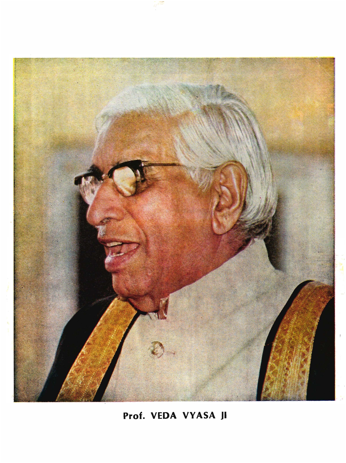
Prof.
Veda Vyasa
Prof. Veda Vyasa had been actively associated with the D.A.V. Organisation for the more than 58 years and had rendered a Yeoman’s
service to the Nation in the various fields of his long and fruitful life
– education, law, farming, freedom movement, religious and social
service.
Prof. Veda Vyasa was born on 1.9.1902 in a small village named Takhat Hazara in Sargodha
District of Punjab (Pakistan). From his early childhood his education took
place in an Aryan institution at Bhera where he
became a close associate of Shri Vishwabandhu who
initiated him in the Arya Kumar Sabha.
While in his
middle teens, he left his scholarly pursuits to participate in providing relief
to the famine stricken in Garhwal in 1918. Two years
later, under the inspiration of Mahatma Hans Raj, the famine
hit people of Orissa claimed his time and youthful services. These
experiences of rubbing shoulders with the suffering humanity activated a new
mental churning in him. Another inner urge of the mind attracted him to early
freedom struggle, generally known as The Non Cooperation Movement, motivated to
shatter the shackles of subjection. Under the leadership of Mahatma Gandhi and Lala Lajpat Rai, he participated
in the Non-Cooperation movement. Young Veda Vyasa
fired with youthful zeal, undertook to spread the new message, by touring
Punjab and specially concentrated his activities in the rural areas of Hissar.
In 1922, Shri Veda Vyasa was sent by Bhai Parmanand to Nepal for a first-hand study of what
revered Bhai ji described as the only independent
Hindu Kingdom in the world. This was the most valuable experience for him. In
Kathmandu, he came in contact with Dr. Sylvain Levi, one of the most eminent Indologists of world, who became very kind to him and
invited him to study with him at Shantiniketan for
one year.
In pursuit of a
nobler cause, he allowed his studies to be neglected; nevertheless, the intellectual
genius surfaced. He appeared in 1923 from D.A.V. College, Lahore, and graduated
in Sanskrit (Hons) securing First Class First. The
same year he threw himself heart and soul into the Shuddhi
Movement in Mainpuri District of Uttar Pradesh. He
was successful in bringing back to the old fold Malkana
Rajputs who had been forcibly converted to Islam by
the Mughals. These activities deprived him of 19 months of study for the
Master’s Degree. He was, however, goaded by his teacher, Acharya Vishwa Bandhu, to sit for M.A. in
Sanskrit. Luck and pluck, concentrated devotion and deep desire, produced
unanticipated reward for his prodigy.
His has been a
brilliant academic career of attaining ‘first classes’ and creating records.
The record set by him for his M.A. in Sanskrit in 1924 at the Punjab University
remained untouched for more than 20 years. His special fields of interest had
been History, Sanskrit and Indology. He took the Law Degree in 1928 rather
casually as he had never imagined that it would one day be his profession. He
was a favourite student of Dr.
A.C. Woolner, the then Vice-Chancellor of Punjab
University, a great Sanskrit Scholar and an Indologist.
Dr. Woolner encouraged his favourite
and bright student Ved Vyas by
appointing him as lecturer for M.A. classes at the young age of 22 years in
1924. Contemporaneously he was appointed Professor of Ancient Historic
Research. Three years study of Ancient Indian Colonies of Cambodia and Funan (Modern Vietnam) resulted in authorship of a work of
300 pages of scholarly book ANGKOR. He authored the book on Indian History in
simple style which turned out to be an ideally suited
text-book for High School students and was sold in large numbers.
Abruptly, he
swerved in a different direction. In 1928 the lover of Sanskrit was lured to law which, in a short time, brought him lucre. He also made
the land yield to his farm wealth. The hitherto scholar, teacher, lecturer,
traveler, social worker, author, lawyer, now became a large scale scientific
farmer, at first in the district of Gujarat in West Punjab and later in Uttar
Pradesh.
Some of his
friends and admirers wanted to see him take active lead in other and perhaps
even more significant purposes of Arya Samaj as
conceived by its great founder. Arya Samaj no less so
now than ever before has to carry the message of the world’s most ancient Vedic
culture, the noblest and the sublimest, to mankind
and to bring back in its fold, the misguided who under coercion, cajolery,
temptation or want, had strayed away. The task ahead is tremendous and let a
new and reinforced lead by given by Prof. Veda Vyasa
and his friends, who profess and stand by Vedic inspirations, and Vyasa’s intellectual and oceanic depth and breadth.
Prof. Veda Vyasa has been at one time actively involved in editorial
and publishing business at various levels. Firstly, he had started a Law
reporting journal in which he put in great effort and time and also staked his
entire fortune. At that time AIR, another Law journal being published from
Nagpur, has a monopoly in its sphere and it was certainly a great challenge to
compete with it. This new venture made very exacting demands on him and his
brother Late Shri Amar Nath, also a Senior Advocate.
While they were at the point of turning the corner, the AIR used all possible
pressure tactics to stranglehold this new rival journal and they succeeded in
their designs and the journal folded up with heavy losses. It was a very
difficult time for Veda Vyasa Ji
and he had to face its aftermath. Just as dark clouds have a silver lining,
this financial crisis also did a good turn to him. He was obliged to appear
personally to argue the case brought against him by his creditors and he did it
so successfully that the Chief Justice of Punjab High Court, Sir Douglas Young
himself suggested that he should adopt law as his career. He even made an
exception for him that he could start practice directly at High Court instead
of the usual three year stint at lower courts. He rose
to a position of eminence in his profession steadily and at the time of
partition of the country in 1947 he was among the top lawyers of the Punjab. Infact, he was the legal advisor of Shri Lal Bahadur Shastri
also.
Prof. Ved Vyas was a man of many parts. He has a wide range of
abiding interests ranging from literature to law, from agriculture to
archaeology, and from history to Indology. It is rather difficult to say which
of these interests has been more dominating. He was a person who did equally
well in the field of law and farming. After the partition of India he devoted a
lot of his time and efforts and energies in building up an extensive
agricultural and started applying the latest technique in this own farm. In the
process, he came to be recognized as a knowledgeable person on the subject and
was taken on the Board of G.B. Pant Agricultural University of Pantnagar (U. P.) which position he held for a number of
years. He was one of the promoter Directors of the Tarai
Development Corporation which was later used by the
World Bank as a model for similar corporations in other developing countries.
His rich experience about farming enabled him to introduce the concept of
Social Forestry and Experimental Farms in some of the D.A.V. institutions
which were suited for the purpose.
To talk about
his interest in publishing, he has started a rather ambitious All India Law
Reporting Journal which later ran into trouble and has
to cease publication. But at Lahore he has launched another publishing project
for the publication of text-books for students and also
a well-planned programme of translation and
publication of world classics into Hindi under the imprint of Vishva Sahitya Granth Mala. For the first time, text-books
were assigned to imaginative and innovative writers instead of professional
hack writers. These text-books were an instant success
and became the envy of other publishers. One of his book
rather became a trend-setter. Its title was Aajkal
and it touched upon the great developments taking place in the society. As a
book of this type would not fit into any syllabus, an exception was made by the
Punjab University at the instance of Sir Manohar Lal, the then Education Minister, to prescribe this book in
view of its fresh and innovative approach. Similarly, for the first time,
readers of Hindi books were made aware of the writings of the great French,
Russian and English writers through first-rate translations of their works. It
was indeed a pioneering work through which windows on World Literature were
opened for the Hindi readers. It will not be out of place to mention that Shri Chandergupt Vidyalankar was his
associate and partner in this publishing programme.
He also had a
very intrinsic interest in and uncommon aptitude for Indological
research which was further confirmed when Prof. S. Bhaskaran
Nair – Director, V.V.R. Institute, Hoshiarpur,
in the capacity as the editor of the BharatiBhanam or
the Light of Indology obtained research article from Prof. Vyasa
on “Harappan Wars of Seven Generations”. He went
carefully through it for the purpose of its editorial processing. Later on, in
October, 1981, he presented this article to the Fifth World Sanskrit Conference held at Varanasi and received warm
appreciation from the concerned scholars. Likewise, another article of his on
“Destruction of Harappa”, which he presented to the Third World Sanskrit Conference held at Paris in June, 1977, was
highly appreciated by such savants as the late Dr. V. Raghavan,
the then President of the International Association of Sanskrit Studies; the
late Prof. Jean Filliozat, the doyen of Oriental
Studies in France; and the late Dr. Ludwik Sternbach of Polish origin, the then Secretary-General of
the said Sanskrit Association.
In 1978, he was
asked by the late Shri Suraj Bhan
to carry on his work as the President of the D.A.V. College Managing Committee
and later, on the demise of Shri Suraj Bhan, he was elected as the President of the D.A.V. College
Managing Committee. His outlook in respect of everything was optimistic. The managing
committee had only two or three model schools before he became the President.
It is he who visualized that there was great scope of Public Schools and
thought of opening 500 schools in the course of 5/10 years. In the beginning it
was a risk which was worth taking and he took it.
These Public Schools, at that time, had, to a great extent, stopped the
children’s trend of going towards Christianity. The children were taught Vedic
Culture in these schools. In this way the Managing Committee rendered a great
service towards the Hindu society. His thought of giving education to the
children of weaker sections was very praise-worthy.
Under his presidentship, a new life and dynamism was been infused in
the D.A.V. Movement. While earlier the approach and outlook used to be
conservative and rigid, later the emphasis came on flexibility, modernization,
expansion and consolidation. He has been able to take the movement out of the
grooves and give it a new momentum. D.A.V. Movement being more than 100 years old, has naturally became tradition bound and a bit
retrograde. Prof. Ved Vyas had been able to give it a
purposeful direction to meet the challenges of the 21st Century.
Under his stewardship a chain of D.A.V. Public Schools, almost 100 in number,
have been opened to impart the latest and best in education for the young boys
and girls. These schools measure up to the latest norms of public school
education and are well equipped for sports and extra-curricular activities.
Another new and
significant dimension for which credit entirely go to Shri Ved
Vyasji is his dream of taking D.A.V. education across
the seas, to countries where people of Indian origin have been asking for it.
It was no mean achievement that later D.A.V. Institute of Indian Studies
started functioning in association with the New York University and also
D.A.V. Public Schools and Colleges
in London, Bangkok and Mauritius. He had the spirit of an explorer and
adventurer in him. At that ripe age also he loved travelling and in fact
travelled a lot. He was always ready to go anywhere and to any length for the
cause of the D.A.V. Perhaps it was not known to many that he used to make
handsome princely donations to the D.A.V. Trust and was the single largest
donor to this cause in those years.
The life of a
busy and much sought after advocate involves, always, lots of stresses and
strains. Of these Prof. Veda Vyasa had no small
share. He could see the handicaps and hurdles involved in sticking to a course
of rigid honesty and uncompromising integrity. Even so he refused to
‘compromise’ on principles. Forging ahead, with determination and with faith in
his own capabilities, he reached the ‘summit’ and had
been for many decades a legal luminary of the highest distinction. All this,
and much more, he attained entirely on the strength of his untiring and
dedicated hard work; his sterling merit and on the
basis of his reputation for unimpeachable integrity. To Prof. Vyasa it is not the ‘end’ alone that matters. He is
concerned, equally, with the means adopted to achieve that ‘end’. To be ‘right’
and ‘straight’ – was his highest religion. Even his worst critic would
not say that at any time Prof. Vyasa did something which could be termed unethical or lacking in
grace. That is why he was known, all around, to be a man of principles who
would not compromise on his ethics or his standards of high morality.
Once asked, how he would view his own life in
retrospect, he summed it up succinctly as follows:
“Many dreams
Many setbacks
Modest achievements
No regrets.”
He was really modest of a man of so many achievements
in various spheres of life.